


Showing posts with label History. Show all posts
Showing posts with label History. Show all posts
Tuesday, 28 October 2008
Sunday, 26 October 2008


Sunday, 14 September 2008

Saturday, 30 August 2008
Sunctuary of Delphi (part 1)
The Sanctuary of Delphi is in a part of ancient Greece called Phokis, north across the Gulf of Corinth from Olympia and the Peloponnese. It was easily accesible from the Peloponnese by sea, and from the east (Veotia, Attica, Chalkis, Eretria) by road-the same road Oedipus took when he left Delphi after consulting the oracle-and it stood close to the north-south route that ran from the Peloponnese to Thessaly. It did not stand, like Olympia, on flat ground, but rose steeply from the precipitous slopes of Mount Parnassos.It faces south; springs crevices, and rocks around.

Like Olympia, it was not under the control of a major settlement but developed on the margins of established powers; so it was essesntially neutral. It was this character of neutrality that allowed Delphi and Olympia to become significant interurban sanctuaries, where poleis (cities) and elite individuals could compete in shows of strangth and wealth on an equal footing.
The Greeks themselves thought that Delphi was the center of the earth, and Pindar described it as the shared heart of Hellas (Greece). Legebd had it that Gaia (Mother Earth, the first prophetess) resided here with her son Python, the snake.; hence, the games here were called the Pythians games, and the priestess who delivered the oracles was known as the Pythia. It was only after Apollo had killed Python that he was able to take over from Gaia, and the sanctuary became his. However, even in the periods of greatest development of Apollo's sanctuary, a small area was always left uncluttered and revered: Python's Cave, Sibyl's Rock, and the spring called Cassotis.
(to be continued in part 2)

Wednesday, 27 August 2008
Some notes on the excavation history of Delphi site
Archaeological research in Delphi began in 1860 by Germans. In 1891, the Greek government granted the French School in Athens permission for long-term excavations on the site. It is then that the village of Kastri was removed to allow for the so-called “Great Excavation' to take place.
The Great Excavation uncovered spectacular remains, including about three thousand inscriptions of great importance for our knowledge of public life in ancient Greece. Today, the Greek Archaeological Service and the French School in Athens continue to research, excavate and conserve the two Delphic sanctuaries. Of all the monuments, only the Treasury of the Athenians had enough of its original building material preserved to allow for its almost complete reconstruction. The project was financed by the City of Athens and carried through by the French School in 1903-1906. The Chiot altar, the temple of Apollo and the Tholos were also partially restored. In 1927 and 1930, the poet Angelos Sikelianos and his wife, Eva, attempted to revive the Delphic idea and make of Delphi a new cultural centre of the earth, through a series of events that included performances of ancient theatre.
Delphi
Apollo squinted in the bright sunlight and calmly tensed his muscles as he pulled his bow. He released his arrows one after the other until Python's blood was spilled and his life escaped in the thin air. Python-dragon,the faithful guardian of Ge's sacred ground, had guarded the hill for hundreds of years until his encounter with "far-reaching" Apollo. The new god despite his serene nature, or perhaps because of it, was triumphant in the epic battle, and with his victory he gained the right to call the rolling slopes of Delphi his sanctuary.
Oracle at Delphi
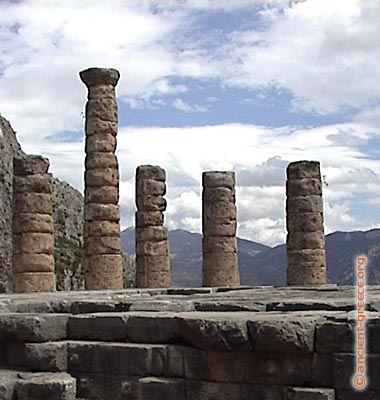
The ancient people of the Mediterranean had such faith in Pythia's view of the future that no major decision was made without consulting the Oracle of Delphi first. Greek and foreign dignitaries, heads of state, and common folk made the pilgrimage to the Delphi sanctuary, and paid great sums for Pythia's oracles. Since the sanctuary only served the public a few days over nine months out of the year, great sums were paid by the more affluent ones in order to bypass the long line of pilgrims.
Plutarch served as a priest at Delphi, and in his histories he has left many details about the inner workings of the sanctuary. Pythia entered the inner chamber of the temple ("Adyton"), sat on a tripod and inhaled the light hydrocarbon gasses that escaped from a chasm on the porous earth. After falling into a trance, she muttered words incomprehensible to mere mortals. The priests of the sanctuary then interpreted her oracles in a common language and delivered them to those who had requested them. Even so, the oracles were always open to interpretation and often signified dual and opposing meanings.
"You will go you will return not in the battle you will perish" was an example of this duality of meaning. The above sentence can be interpreted two different ways depending where the comma can be placed. If a comma is placed after the word "not" the message is discouraging for him who is about to depart for war. If on the other hand the comma is placed before the word "not", then the warrior is to return alive.
Delphi Sanctuary
Such was the importance of the Oracle at Delphi that the ancients believed it to be the center ("Omphalos") of the world. The oracle advised the great Persian Kings of the time, and when the Persians were poised to sack Athens, Themistokles turned the advice of the Oracle to a winning strategy that led to the Greeks' victory in the naval battle of Salamina. The Oracle had simply advised that "wooden walls" would aid to victory, and Themistokles interpreted walls to mean the wooden ships of the Athenian fleet.
To commemorate the triumph of Apollo over Python the sanctuary organized the Pythian Games every four years which were athletic events much like the Olympics. In the 20th century Angelos Sikelianos organized a modern version of the Delphic games.
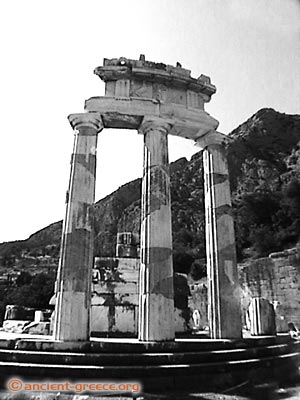
In 339 B.C. Philip interfered once again against the Amphictyonic alliance when the Krissans trespassed on Apollo's sacred grounds. Philip punished the Krissans, and consequently in 338 c. B.C. defeated the combined armies of the Athenians and the Spartans, thus becoming the dominant force in Greek affairs.
The sanctuary of Delphi fell into Roman hands in 191 B.C, and was stripped of its treasures by General Sylla in 86 B.C. in order to finance his siege of Athens, and three years later Delphi was razed by the Thracian Maedi who -legend has it- extinguished the sacred fire which had been burning uninterrupted for centuries.
Despite some building revivals by the Romans, the Oracle of Delphi lost its influence over the next few centuries, and its spiritual fire was gradually extinguished as Apollo's worship was replaced by a new religion imported from the East: Christianity.
Subscribe to:
Posts (Atom)


 Posts
Posts


